

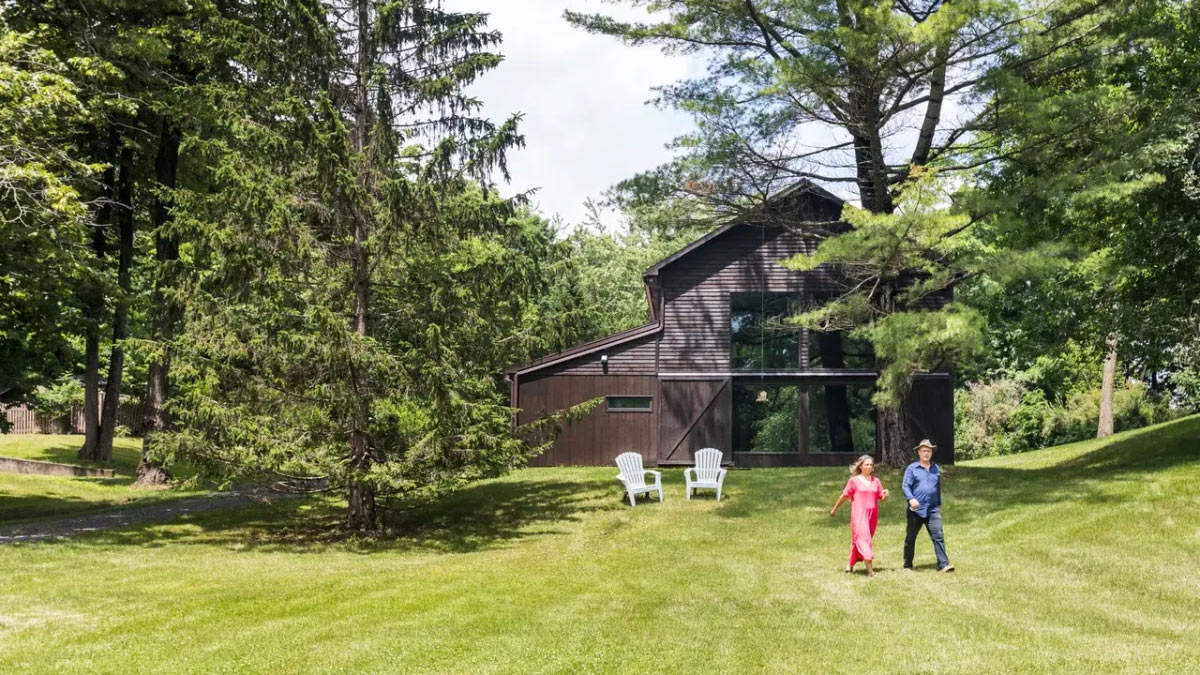
Patrick Lo Re and Sabrina Mitre walk by their former three-car garage, now a performance venue and recording studio. Once an orchard, part of the appeal of their six-acre property was the quiet and the sense of being enveloped by both nature and the hamlet of New Baltimore. “It’s an intimate space that offers the possibility of going inward and outward,” explains Lo Re. “Just like the creative process: you can withdraw, feel the protection of nature, and then be open and share by being in community. Credit: Winona Barton-Ballentine
When you ask Patrick Lo Re why he decamped from the wilds of Manhattan for the rolling bucolic hills of the Hudson Valley, his answer is to the point. “In one word, the sound experience of New York City is: noise,” explains the audio engineer—who, in his quest to perfect the art of recording music, has learned to play several instruments, as well as studied architecture, material science, and a bit of physics. In 2006, when he found his architecturally inspired raised ranch nestled on six acres in the quiet hamlet of New Baltimore, he relished the calm. “Coming back to nature was about opening up,” he explains of his move upstate. “I found in Manhattan I was unconsciously protecting myself. The experience is not harmonious. Here, nature offers sounds you want to hear. ”
Lo Re loved the modesty of the 2,200-square-foot house, which is clad in dark brown cedar shingles and blends with the surrounding landscape, once part of a larger orchard, and still filled with gnarled apple, pear, and cherry trees. To invite more of the park-like setting inside, he installed walls of picture windows and sliding glass doors leading to a wooden deck, a wisteria arbor, and pool. “Part of the American dream for me was the appeal of the wood cabin,” says Lo Re, who grew up in Europe. “After Manhattan, disappearing into nature became vital. I loved the chance to reconnect with the Earth.” The three-bedroom home became a haven for Lo Re, who travelled the world designing and building recording studios for clients. In 2010, he met his wife, Sabrina Mitre, a writer and former fashion executive who quickly saw the appeal of the property and joined him in his pursuit of quietude.
In 2020, when construction on a studio in Maine was halted by the pandemic, Lo Re saw an opportunity to fulfill a long-held dream. “The first time I came up the driveway here I had deja vu,” he says. “I knew that at some point I could make the perfect sound studio and retreat.” Originally Lo Re had searched for a home with a barn to convert. “But the acoustics of barns aren’t actually conducive to sound recordings,” he explains. The raised ranch didn’t have a barn, anyway—but it did have an architecturally uninspired three-car garage. “I had my team together and none of them wanted to go back to the city,” he remembers. “So I spoke to Sabrina about them staying awhile and designing a new studio.” Mitre agreed. “We became like a family,” she says. “With me cooking and taking care of the team over the next six months. It was fun.”
